








Hupside is an original intelligence scoring platform for content and the teams that create it. We measure Original Intelligence, the capacity to create originality beyond common AI, and build the tools to apply it. Hupside has two live products. Hupmapper scores how far a piece of content diverges from what common AI would produce, and Hupchecker measures Original Intelligence capacity in people and teams.
Original Intelligence is the measurable capacity to create originality beyond common AI. It describes the differentiated thinking, judgment, and novelty that stay scarce once AI makes polished output cheap and abundant. Original Intelligence is its own measurement standard, separate from creativity scores, IQ tests, personality assessments, and AI detectors. Hupside measures how original a person's thinking or a piece of work is compared to common AI, and the people using that measurement decide what it's worth to them. Original Intelligence is the new standard for measuring originality beyond common AI.
AI has made polished output cheap and abundant, which has led to what Hupside calls signal collapse. Credentials, deliverables, essays, and other written work used to prove effort, judgment, and expertise. Now nearly everything reads well, so hiring managers, educators, and business leaders lose the ability to tell what is original. Original Intelligence gives them a signal built for that condition.
Hupmapper is Hupside's originality scoring tool for writing. Paste in a piece of content and Hupmapper returns an Originality Intensity (OI) score from 0 to 300, showing how far the writing diverges from what common AI would produce for the same task. It also breaks the document into Originality Zones so you can see where the original thinking sits. Hupmapper scores the work in how far it diverges from common AI, independent of how that work was created. Try Hupmapper.
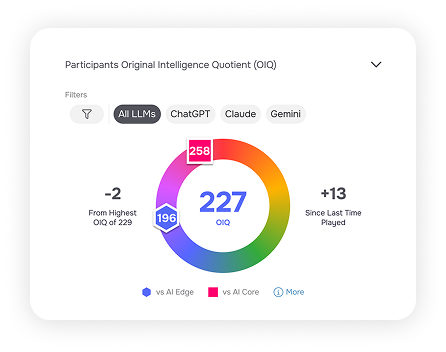
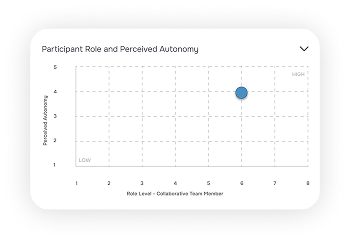
Hupchecker is Hupside's tool for measuring Original Intelligence in people and teams. Participants complete a 12 to 15 minute interactive experience with open-ended prompts, and no preparation is needed. Each person receives an OIQ Profile with an OIQ Score, an OIQ Archetype, and contribution signals that show how they pair with AI and with other people. Leaders see results for each individual and across the team in the Hupchecker dashboard.
Both are calibrated against common AI, and each one measures something different. An Originality Intensity score comes from Hupmapper and describes one specific piece of writing on a 0 to 300 scale. An OIQ Score comes from Hupchecker and describes a person, measuring how far their responses tend to sit beyond what common AI would produce. Organizations use Originality Intensity for document review, output scoring, and use OIQ for training, development, and team design.
No. AI detectors try to determine whether AI was used to produce something. Hupside measures how much originality a piece of work or a person brings beyond common AI, regardless of which tools were involved. Someone who uses AI heavily can still earn a high Hupmapper score by pushing the result into new territory, and fully human writing can score low if it stays close to what common AI already produces.
Hupside serves organizations that need a signal of performance when originality is a goal. That includes enterprise teams that need to know who is adding originality beyond common AI, higher education institutions evaluating applicants and student work, and government agencies and contractors that need original, auditable analytical work. Consulting and professional services firms, along with brand, marketing, and creative teams whose work depends on distinctive thinking, also use Hupside. Organizations in government, commercial, and education markets can purchase Hupside through Carahsoft.
Yes. Hupside's scoring technology was invented by co-founder and CTO Dan Johnson, who has spent more than 10 years building tools for the automated measurement of original thinking. His peer-reviewed work includes the divergent semantic integration method published in Behavior Research Methods, the SemDis and CAP open research platforms, and the Maximum Associative Distance method for scoring novelty. His research collaboration with co-founder Dr. Adam Green, a Georgetown University neuroscientist, led to Original Intelligence. Hupside validates Originality Intensity against openly available datasets from peer-reviewed research, so outside researchers can replicate the analysis. Read more on Hupside's research page.
Individuals can paste your content into Hupmapper to see its Originality Intensity score, or take the OIQ Challenge to see their own OIQ Score and Archetype. Organizations that want to measure Original Intelligence across a body of work, a team, or an applicant pool can contact the Hupside team to talk through their use case.
