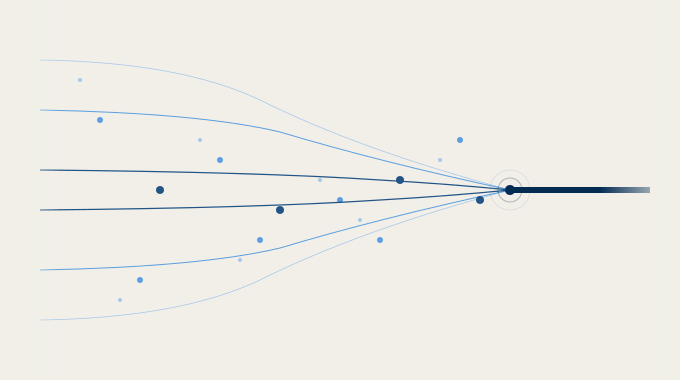
AI adoption creates noise.
Hupside brings you the signal.
AI output, so you know where real value lives in your organization.

Our Approach
The question worth asking isn't whether a student used AI. It's what they did with it.
Most tools built for this moment ask whether or not AI wrote the essay. That question is hard to answer reliably, and it misses the point. AI is the new floor every applicant starts from now, not a red flag to chase down. The way applicants are interacting beyond the baseline is the important distinction, and it's a measurable one.


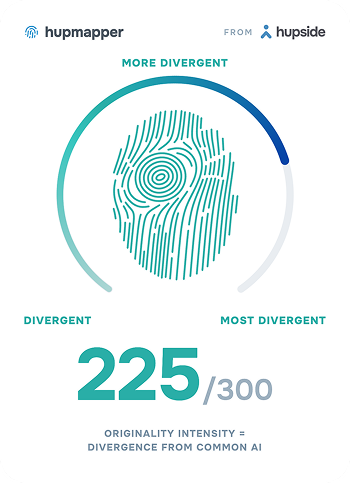
Hupmapper scores each submitted essay against common AI
The score reflects how far the finished piece exceeds what a model would produce unaided, giving your office a signal that isn't clouded by whether AI was used at all.
It traces originality of output rather than originality of authorship
Hupmapper evaluates what the finished piece contains, rather than how it was written, so your readers are working from a signal about the student's thinking, not a guess about their process.
The score is a prioritization signal, not a verdict
Essays that go beyond common AI are flagged for full reader attention, while essays using or close to common AI still get reviewed, just with reader time allocated where it's most likely to pay off.
This approach draws on the research of Dr. Adam Green
A Georgetown University neuroscientist and Hupside co-founder, who found that this method identified original thinkers more accurately than trained human admissions readers with the same files.
A low-lift data service that fits into your review process.
Hupmapper is delivered as a data service, not new software your team has to learn. Your office shares its applicant essays, Hupside scores the full pool, and your team gets the results back in time to use them.
The Problem
The problem isn't that applicants use AI. It's that offices have no way to see past it.
Every applicant now has access to the same tools, and reader time hasn't grown to match. Offices need a way to tell which essays reward a closer look, and right now most don't have one.
Reader capacity is stretched thin
Many reviewers move through hundreds of files per cycle, leaving little room to weigh nuance in any one essay.
The essay is a weaker signal than it used to be
A large share of applicants draft with AI assistance, so the writing sample that once showed individual thinking now often reflects a model's patterns instead.
Detection tools ask the wrong question
AI detectors try to determine whether a human or a machine wrote something. That question gets harder to answer with every model release, and isn't the one that determines whether a piece is worth reading.
The research points to something specific
Across hundreds of thousands of personal statements, Georgetown neuroscientist and Hupside co-founder Adam Green found that essays are converging toward a narrower set of structures and themes.
By the Numbers
What admissions offices are working with
What's actually happening in applicant pools right now
10M+
Applications
Common App logged more than 10 million first-year applications in the 2024–25 cycle, and that number keeps climbing every year.
~50%
Used AI to brainstorm
About half of applicants used AI to brainstorm their essay, and roughly one in five used it to generate a first draft.
8x
More novel ideas
Across 2,200 essays studied, human-written essays collectively generated up to eight times more novel ideas than AI-assisted ones.
61.3%
Misclassified
AI detectors wrongly flagged more than six in ten essays from non-native English speakers as AI-generated.
Everything you need to know
Frequently Asked Questions
No. Hupmapper measures how much a piece of writing exceeds common AI. It does not make a determination about process, which keeps your office out of the false-positive risk that comes with AI detection tools.
No. Originality scores are designed to sit alongside your existing rubric and committee process as an additional data point, not a replacement for any part of your current review.
Most offices spend two to three hours preparing files for submission, and scored data typically returns within about a week.
Hupchecker Admissions is a separate, optional live assessment your office can use for recruiting, yield, and enrollment decisions. It is not required to use Hupmapper for essay scoring.
All scoring happens on U.S. infrastructure with no third-party AI ingestion of student materials.