
Key Takeaways
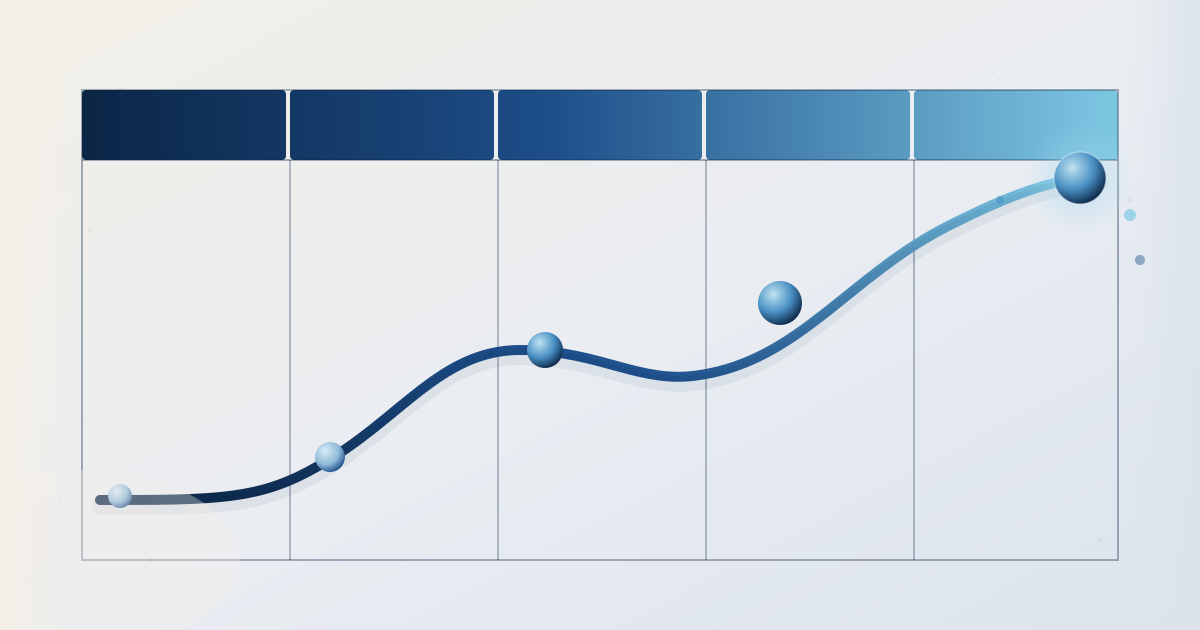
- Gartner's AI Maturity Model has five levels, Foundational, Emerging, Operational, Scaled, and Transformational. Most organizations overestimate which one they're in based on how much AI activity is visible rather than what it's producing.
- The most common stall point is the move from Emerging to Operational, sometimes called pilot purgatory, where proofs of concept multiply but never convert into a funded, owned production system.
- The fix depends on where an organization is stuck: Emerging is a funding and ownership problem, Operational is a knowledge-sharing problem, and falling short of Scaled is usually a people-fluency problem more than a technical one.
- Gartner's framework confirms whether an organization is equipped to run AI at scale, not whether the people running it are producing anything AI couldn't have produced alone, which is the layer Hupside was built to measure.
Most organizations have moved past the question of whether or not to use AI, and have now reached the harder question: whether that use is actually producing value. For most companies, the answer is unclear. Adoption has become widespread, and measurable return has stayed rare. That gap is exactly what Gartner's AI Maturity Model was built to explain.
The model gives organizations a way to locate themselves on an AI adoption path, along with a framework for figuring out what stands between them and the next stage. This explanation focuses on how to use the Gartner model by finding what stage you’re in, what typically blocks progress, and how to move forward. For a broader look at readiness beyond the model itself, see Hupside's guide to AI readiness and maturity.
The Five Levels of the Gartner AI Maturity Model
Gartner's widely cited model describes five stages of organizational AI maturity, and each one has a recognizable set of behaviors. Gartner also scores organizations across seven underlying pillars, including strategy, data, governance, engineering, operating model, culture, and AI product value, which is what makes the model useful as a diagnostic rather than just a label.
Foundational: AI is a topic of conversation but not yet a practice.
- Leaders and teams talk about AI's potential and float use cases, but nothing gets built or tested. This is where the largest share of organizations sit.
Emerging: experimentation begins.
- Teams run proofs of concept (often department by department) usually without enterprise coordination or shared governance. This stage tends to be driven by a few enthusiastic teams pushing forward while the rest of the organization watches.
Operational: the first stage where AI is used in production.
- At least one AI initiative has an executive sponsor, a dedicated budget, and defined ownership. Expertise starts circulating across the organization rather than staying siloed with the original team.
Scaled: AI stops being a project and becomes a default consideration.
- Every new digital initiative starts with the question of whether AI belongs. Most employees understand the technology well enough to build with it, and AI systems interact productively across the business.
Transformational: AI is embedded in the organization's operating rhythm, touching nearly every process.
- Every employee understands their strengths and limits, and is directly responsible for new revenue streams and competitive positions.
Finding Your Actual Stage
Most organizations guess their stage based on how much AI activity is visible, often overstating maturity. A useful check would be to read through the five stages in order and stop at the first one where you can't confidently say "we do that." Your real stage is the one just before that.
A few questions make this concrete:
- Does at least one AI initiative have its own budget line, separate from a general technology or innovation budget?
- If not, you won’t be past Emerging, at best.
- Can someone tell you, with a number, what an AI initiative changed about a business outcome, whether that's cost, time, revenue, or output quality?
- If the answer is "people seem happier with it," you likely haven't reached Operational; Hupside's piece on what AI measurement actually means covers this distinction between activity and impact in more depth.
- Is inclusion of AI a default question in new product or process design, or does someone still have to specifically ask?
- If AI still needs to be raised and only one team could build on it without help, you're not yet at Scaled.
This pillar-by-pillar honesty matters because maturity isn't a single score. An organization can have a sophisticated AI strategy and strong engineering capability, but can still be held back by weak governance or a lack of AI skills among the people expected to use these systems. Your real maturity level is always set by your weakest pillar.
Where Most Organizations Get Stuck, and What Moves Them Forward
The most common stall point sits between Emerging and Operational, a spot informally known as pilot purgatory: proofs of concept keep multiplying, but none of them convert into a production system with an owner, a budget, and a way to measure results. Getting past this point takes a decision most organizations avoid: fund and own one initiative all the way through, instead of trialing another pilot.
The fix depends on where an organization is stuck:
- At Emerging, it's usually organizational. Pick one initiative, name a sponsor, and give it a real budget.
- At Operational, it's usually a knowledge gap. Document what worked, and put someone in charge of spreading it beyond the original team.
- Short of Scaled, it's usually a people problem. Teams need working AI literacy, not just tool access, to raise AI unprompted in planning conversations.
Early on, the bottleneck is structural: no strategy, no budget, no pilot. Eventually, AI absorbs most of the routine cognitive work, and what sets one company apart from another comes down to the people directing it. When everyone uses the same models with the same prompts and takes the first answer without question, value signals collapse, and an organization can look mature on paper while producing work indistinguishable from its competitors.
Where OIQ and Hupchecker Fit Into the Model
Hupside built Hupchecker to answer the question the maturity model leaves open: which people within an organization are adding value beyond common AI, and which ones need different support to get there.
Hupchecker measures Original Intelligence, the capacity to produce ideas and contributions that go beyond what generative AI would produce on its own. It generates an OIQ score calibrated against AI output, along with an OIQ archetype describing how a person naturally generates and shapes ideas. Applied against the maturity model, that gives leaders a few things they wouldn't otherwise have.
The clearest signal an OIQ score provides is identifying who's positioned to lead AI adoption, versus who has simply started using the tools. People with higher OIQ scores tend to push a model further instead of stopping at its first answer, and they're worth positioning as pilots when an organization is trying to move from Operational toward Scaled.
There's also an early warning function: a team leaning heavily on AI while scoring low on Original Intelligence can look efficient in the short term while quietly losing the thinking that made its work worth choosing in the first place. At the team level, knowing the mix of OIQ archetypes helps leaders build groups that complement each other rather than assuming everyone is equally ready, which is the kind of culture and operating-model insight Gartner's framework references but has no way to measure on its own.
Gartner's model tells you whether the organization is built to support AI at scale. Hupchecker tells you whether the people inside it can turn that scale into something original. If your organization is working through its own AI maturity assessment, Hupchecker can show you where your people stand today and what it will take to move them forward. Get your assessment or learn more about how Hupside measures value beyond AI.